One Of Azerbaijan’s Most Active Mud Volcanoes Erupts
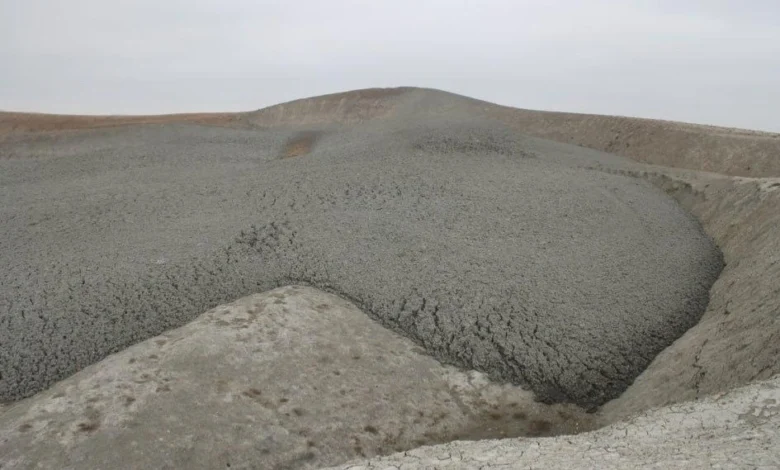
A powerful eruption has occurred at the Durandag mud volcano in Azerbaijan’s Gobustan geological region — one of the country’s most active volcanic sites, according to the National Academy of Sciences of Azerbaijan, Kazinform reports.
The active phase lasted approximately 15 minutes and was accompanied by a towering flame column reaching several hundred meters into the air. A significant volume of mud was ejected onto the surface.
Following the incident, experts from the Institute of Geology and Geophysics, together with representatives of the Ministry of Ecology and Natural Resources, assessed the aftermath. Although the eruption was short-lived, intense natural gas combustion continues in the volcano’s central crater. The fire has spread to the eastern slope of the volcanic structure and nearby vegetation.
Preliminary data indicate that the average thickness of the mud layer reached around 0.9 meters. The affected area covers approximately 14 hectares, with total emissions estimated at 126,000 cubic meters. The eruption also caused notable ground deformation, with multiple radial cracks stretching for several kilometers along the boundaries of the mudflow zone.
This marks the seventh paroxysmal eruption in the history of the Durandag volcano. Previous activity was recorded in 1960, 1968, 1986, 2001, 2004 and 2016.
Scientists are currently conducting field monitoring and laboratory analysis of rock samples brought to the surface. The findings will support further risk assessment and ongoing surveillance of the area.